Carbon Reduction Plan (PPN 006): What UK Suppliers Must Include and Update Every Year


In brief
- A Carbon Reduction Plan (CRP) is a short public document that UK government suppliers must have to bid for major central government contracts.
- The rule is Procurement Policy Note 006 (PPN 006). It replaced PPN 06/21 for procurements advertised on or after 24 February 2025, without changing the policy itself.
- It applies to contracts worth more than £5 million a year (including VAT) let by central government departments, their executive agencies and non-departmental public bodies, where it is relevant and proportionate.
- The plan must commit to net zero by 2050, report Scope 1, Scope 2 and a set list of Scope 3 emissions, be signed off by senior management, be published on your UK website and be updated at least once a year.
Many small and medium firms wrote a Carbon Reduction Plan for one tender, published the PDF and never looked at it again. When we checked plans published by UK suppliers in October 2026, we found plans whose latest figures were for 2023-24, and one whose “current year” table still read “not yet due for reporting” more than two years later. A buyer reading that on your next bid sees a plan that has not been kept. This guide explains what the plan must contain, who needs one, and how to keep it up to date without much work.
Who needs a Carbon Reduction Plan?
You need one if you bid for a contract that falls under PPN 006. That means all three of these apply:
| Test | What it means |
|---|---|
| The buyer | A central government department, one of its executive agencies, or a non-departmental public body |
| The value | An estimated contract value above £5 million a year including VAT, averaged over the life of the contract. For frameworks, the test applies to each call-off contract |
| Relevance | The buyer decides the requirement is relevant and proportionate, for example because the contract uses buildings, transport or natural resources |
| Timing | Procurements advertised on or after 24 February 2025 follow PPN 006; earlier ones stay under PPN 06/21 |
There is no exemption for small firms. A 30-person company bidding for a £6 million-a-year contract needs a plan just like a large one. Councils and housing associations are not covered by PPN 006 itself, but many now ask for the same document in their own tenders. The NHS has its own requirements built on PPN 006, and they change on 1 April 2027: see the 2027 NHS Carbon Reduction Plan requirements.
What must a Carbon Reduction Plan include?
The government publishes a template and a technical reporting standard. The plan is short, often three to five pages, and follows the same headings every time:
| Section | What goes in it |
|---|---|
| Commitment to net zero | A statement that your UK operations will reach net zero by 2050 at the latest (many firms choose an earlier year) |
| Baseline emissions | Your first full year of measured emissions, used as the reference point, with a note on how it was calculated |
| Current emissions | Your most recent full year: Scope 1, Scope 2 and the required Scope 3 categories, in tonnes CO₂e |
| Reduction targets | Where you expect emissions to be in the coming years, usually a projection to a set year |
| Carbon reduction projects | Measures already in place (for example LED lighting, an electric fleet, ISO 14001) and those planned |
| Declaration and sign-off | A statement that the plan follows PPN 006 and the reporting standard, signed by a director or equivalent |
Emissions must cover the seven greenhouse gases of the Kyoto Protocol, reported together as CO₂ equivalent, and should be calculated with the UK Government’s greenhouse gas conversion factors following the GHG Protocol.
Which Scope 3 emissions are required?
You do not need your whole supply chain. The reporting standard asks for five of the fifteen Scope 3 categories, the ones a supplier can measure from its own records:
| Category | What it covers | Data you need |
|---|---|---|
| 4. Upstream transportation and distribution | Deliveries to you that you pay for | Courier and haulier invoices, distances or weights |
| 5. Waste generated in operations | Your office or site waste | Waste contractor reports (tonnes, recycled or not) |
| 6. Business travel | Flights, trains, hotels, mileage in private cars | Expense claims and travel bookings |
| 7. Employee commuting | Staff travel to work, including home working if you include it | A short staff travel survey |
| 9. Downstream transportation and distribution | Delivery of your goods to customers that you do not pay for | Shipment records, if you sell physical goods |
For an office-based business, categories 4 and 9 are often zero or close to it, and the plan can say so. For a full list of the fifteen categories with examples, see Scope 3 emissions explained.
How often must it be updated?
The guidance says the plan should be updated at least annually and stay published and clearly signposted on your UK website. In practice, that means adding each new year’s figures once your financial year closes, refreshing the list of completed projects, and signing it off again. If your plan still shows only a baseline year from 2022, or a current year marked “not yet due”, it is out of date.
A Carbon Reduction Plan is not a one-off tender document. It is a yearly report that buyers can check on your website at any time.
Common mistakes we see
Most problems are small and easy to fix. The figures are old, because nobody owns the update. The “current year” section is left blank or says “not yet due”. One of the five Scope 3 categories is missing with no explanation. Totals do not add up, or the baseline and current tables use different scopes, so the reduction looks bigger or smaller than it is. The plan promises something by a date (“we will measure Scope 3 by end 2025”) and the next version never appears. The PDF is buried in a document library instead of being easy to find. And the sign-off is missing or undated. Any of these can raise questions from an evaluator, and some buyers treat a missing or non-compliant plan as a fail at the selection stage.
How to update your plan in five steps
Step 1: collect one full year of data, usually your last financial year: electricity and gas bills (or your landlord’s recharges), fuel cards and company car mileage, waste reports, travel expenses and a staff commuting survey. Step 2: convert each item into tonnes CO₂e using the current UK Government conversion factors. The free GHG inventory template for Excel does the sums, and the business carbon footprint calculator gives a quick first estimate. Step 3: add the new year to the “current emissions” table and keep the baseline unchanged, unless your business has changed a lot (for example after an acquisition), in which case recalculate the baseline and explain why. Step 4: update the completed and planned projects, and check the reduction projection still makes sense. Step 5: have a director sign and date it, publish it in a clearly labelled place on your website, and replace the old file.
For most small office-based firms this is a day or two of work once the data is in hand. To do it yourself, the Carbon Reduction Plan template follows the government headings with guidance and worked figures. If you would rather hand it over, we prepare and update Carbon Reduction Plans for small firms.
Frequently asked questions
What is PPN 006?
Procurement Policy Note 006 is the UK Government rule that requires bidders for major central government contracts to provide a Carbon Reduction Plan. It replaced PPN 06/21 for procurements advertised on or after 24 February 2025, without changing the policy.
Do small businesses need a Carbon Reduction Plan?
Yes, if they bid for an in-scope central government contract worth more than £5 million a year. There is no exemption based on company size.
How often should a Carbon Reduction Plan be updated?
At least once a year, and it must stay published and clearly signposted on the supplier’s UK website.
Which Scope 3 categories must a Carbon Reduction Plan include?
Upstream transportation and distribution, waste generated in operations, business travel, employee commuting, and downstream transportation and distribution.
Can a subsidiary use its parent company’s plan?
Only if it is wholly owned, the parent’s plan says the commitment applies to it, the measures can be applied by it, and the plan is published on the bidder’s own website.
Sources & further reading
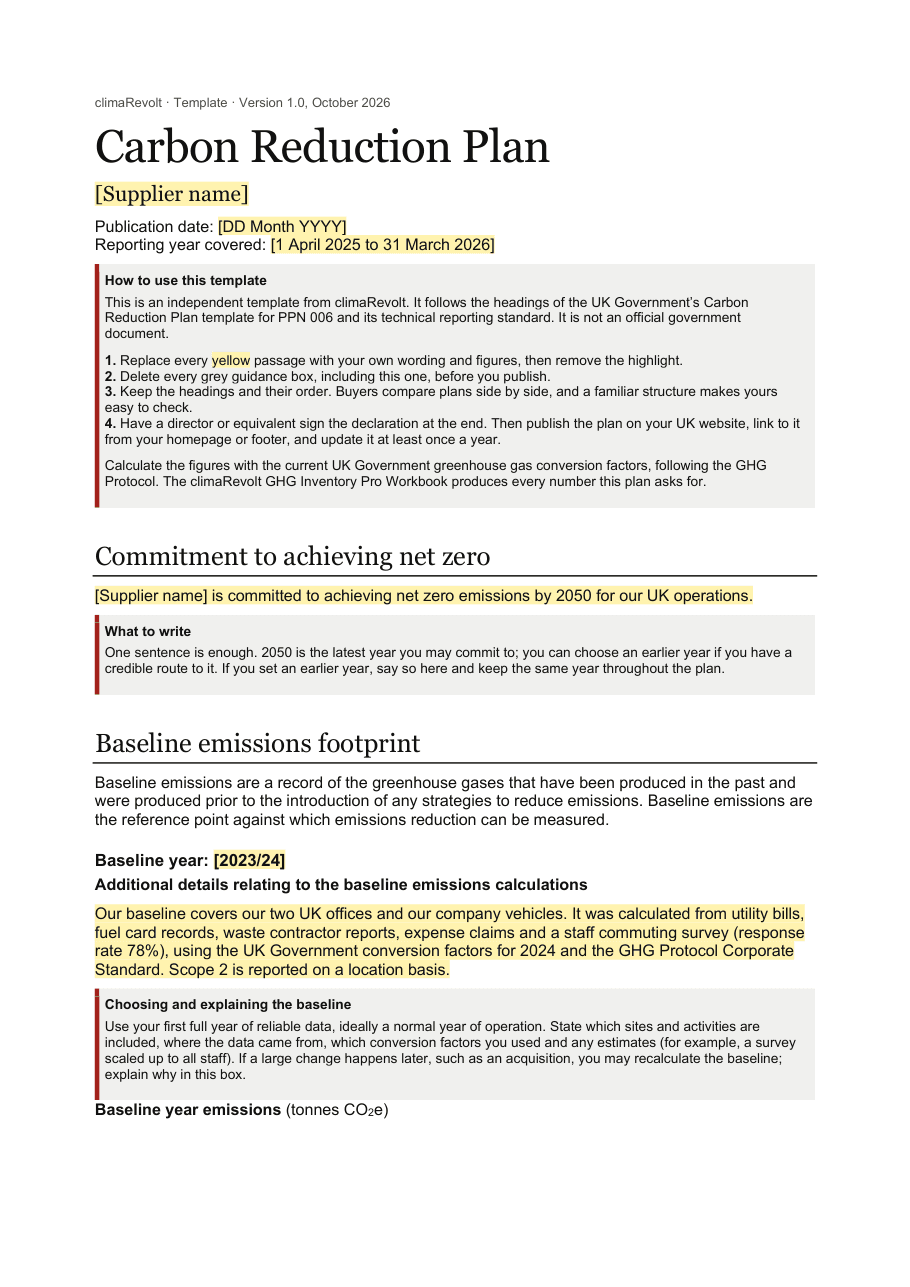
Shop the climaRevolt pick
UK Carbon Reduction Plan Template, PPN 006 (Word)
The plan UK government suppliers need to bid for contracts over £5 million a year, ready to fill in.
$29 incl. tracked delivery
Get the climate stories that matter, explained, every Sunday.
One email a week: new explainers, data and free tools. No spam, unsubscribe any time.
More from climaRevolt

2027 NHS Carbon Reduction Plan Requirements: What Changes for Suppliers on 1 April 2027

What Are NDCs? NDC 3.0 Explained Before COP31
What Is the VSME? The Sustainability Reporting Standard for SMEs, Explained